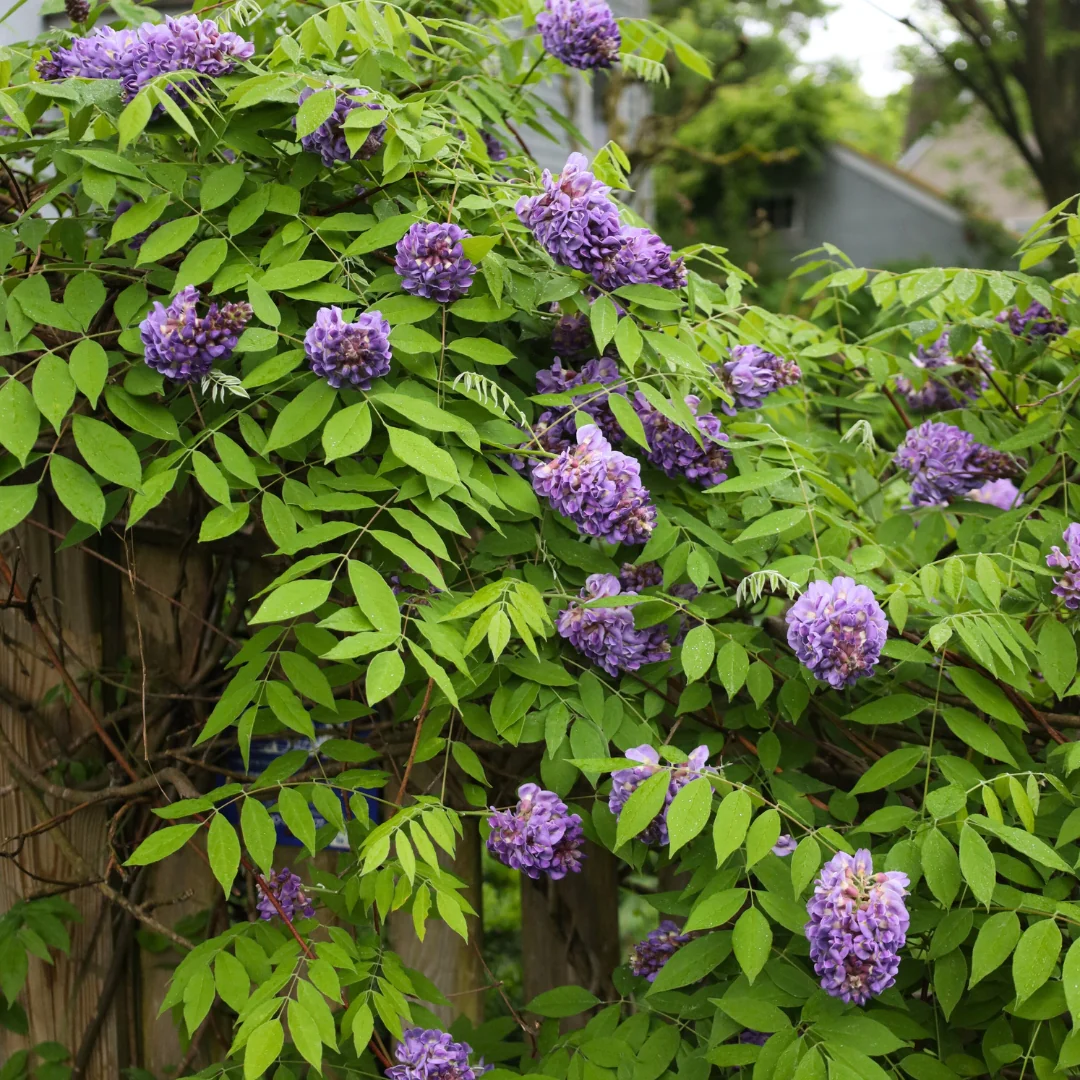
Amethyst Falls Wisteria Vine
A “Wisteria Look” You Can Actually Live With
If you love the idea of wisteria but hate the stories—vines swallowing gutters, strangling trees, and turning pruning into a second job—‘Amethyst Falls’ is the refresh. This is an American wisteria selection that brings the same dreamy, lavender-purple flower clusters and sweet fragrance, but with a growth habit that’s far more cooperative in a home landscape. It’s the kind of flowering vine that gives you the romance of spring blooms without making you feel like you’ve invited chaos onto your property.
The result is a vine that’s easier to train, easier to maintain, and easier to feel good about planting—especially if you’ve avoided Asian wisterias because of how aggressive they can be. ‘Amethyst Falls’ twines beautifully on a trellis, arbor, pergola, or sturdy fence, and it’s often praised for blooming younger than many traditional wisterias. Plant it where you’ll see it often—near a patio, walkway, or entry—and let that early-season burst of color become your yearly “spring is here” moment.
Fast Coverage For Trellises, Pergolas, And Small Structures
‘Amethyst Falls’ can grow quickly once it’s happy, pushing long twining stems that are perfect for turning bare wood and plain fencing into a flowering feature. Early on, you’ll often see rapid extension growth as it learns its support—then, with consistent training and pruning, it fills in and looks more intentional. Over time, mature vines can reach substantial lengths, so think of them as vines with real presence: they can cloak a pergola, soften a railing, or create a flowering privacy moment without needing a huge footprint at ground level.
The key is giving it the right structure from day one. Wisteria isn’t a delicate vine—it’s a woody climber that needs strong, anchored support (not flimsy lattice). If you’re training it up a post, guide one or two main leaders and tie them in loosely, then let side shoots become the flowering framework. This approach gives you better bloom display and a cleaner look than letting it tangle freely. You’ll end up with a vine that reads “designed,” not “overgrown,” and it will keep rewarding you as the framework matures.
Fragrant Spring Flowers That Pollinators Notice
When ‘Amethyst Falls’ blooms, it puts on a show: drooping clusters of lavender-purple, lightly fragrant flowers that feel tailor-made for arbors and porch rails. Bloom typically arrives in late spring, and many gardeners also enjoy repeat flowering when the vine is pruned and grown in good conditions. Even when it’s not in flower, the foliage brings a lush, classic vine look—green, leafy coverage that makes hard lines and tall structures feel softer and more inviting.
This is also a pollinator-friendly choice. Those flower clusters draw attention from bees, butterflies, and hummingbirds, which makes ‘Amethyst Falls’ an easy add for gardens that prioritize life and movement—not just color. If you’re building a “seasonal rhythm” landscape, wisteria can be your spring headline act, followed by summer perennials and late-season shrubs. One practical note: wisteria can form pods and seeds, and those can be toxic if ingested—so it’s smart to place the vine where curious pets and small children aren’t likely to snack on fallen pods.
Pruning And Spacing That Keep It Blooming And Beautiful
Wisteria success is less about “green thumb magic” and more about two simple skills: spacing and pruning. For spacing, give the plant room at the base so air can move, and you can access the trunk for training—crowding it into tight corners makes everything harder later. Plan for the vine to spread along its support, and set it up so stems can be tied, guided, and maintained without climbing on ladders every weekend. A little planning now prevents the classic wisteria problem: a gorgeous top with a messy, shaded, unmanageable base.
For pruning, timing is everything. Light trimming right after the main bloom helps keep the vine tidy and can encourage additional flowering. Then, a more structural prune in late winter lets you shape the framework, control size, and direct energy toward flower-bearing spurs instead of endless whip growth. This two-step rhythm is the “secret” to getting reliable blooms and a vine that behaves. Done well, ‘Amethyst Falls’ becomes the kind of plant that looks high-maintenance—but actually isn’t—because you’re working with it, not fighting it.
A “Wisteria Look” You Can Actually Live With
If you love the idea of wisteria but hate the stories—vines swallowing gutters, strangling trees, and turning pruning into a second job—‘Amethyst Falls’ is the refresh. This is an American wisteria selection that brings the same dreamy, lavender-purple flower clusters and sweet fragrance, but with a growth habit that’s far more cooperative in a home landscape. It’s the kind of flowering vine that gives you the romance of spring blooms without making you feel like you’ve invited chaos onto your property.
The result is a vine that’s easier to train, easier to maintain, and easier to feel good about planting—especially if you’ve avoided Asian wisterias because of how aggressive they can be. ‘Amethyst Falls’ twines beautifully on a trellis, arbor, pergola, or sturdy fence, and it’s often praised for blooming younger than many traditional wisterias. Plant it where you’ll see it often—near a patio, walkway, or entry—and let that early-season burst of color become your yearly “spring is here” moment.
Fast Coverage For Trellises, Pergolas, And Small Structures
‘Amethyst Falls’ can grow quickly once it’s happy, pushing long twining stems that are perfect for turning bare wood and plain fencing into a flowering feature. Early on, you’ll often see rapid extension growth as it learns its support—then, with consistent training and pruning, it fills in and looks more intentional. Over time, mature vines can reach substantial lengths, so think of them as vines with real presence: they can cloak a pergola, soften a railing, or create a flowering privacy moment without needing a huge footprint at ground level.
The key is giving it the right structure from day one. Wisteria isn’t a delicate vine—it’s a woody climber that needs strong, anchored support (not flimsy lattice). If you’re training it up a post, guide one or two main leaders and tie them in loosely, then let side shoots become the flowering framework. This approach gives you better bloom display and a cleaner look than letting it tangle freely. You’ll end up with a vine that reads “designed,” not “overgrown,” and it will keep rewarding you as the framework matures.
Fragrant Spring Flowers That Pollinators Notice
When ‘Amethyst Falls’ blooms, it puts on a show: drooping clusters of lavender-purple, lightly fragrant flowers that feel tailor-made for arbors and porch rails. Bloom typically arrives in late spring, and many gardeners also enjoy repeat flowering when the vine is pruned and grown in good conditions. Even when it’s not in flower, the foliage brings a lush, classic vine look—green, leafy coverage that makes hard lines and tall structures feel softer and more inviting.
This is also a pollinator-friendly choice. Those flower clusters draw attention from bees, butterflies, and hummingbirds, which makes ‘Amethyst Falls’ an easy add for gardens that prioritize life and movement—not just color. If you’re building a “seasonal rhythm” landscape, wisteria can be your spring headline act, followed by summer perennials and late-season shrubs. One practical note: wisteria can form pods and seeds, and those can be toxic if ingested—so it’s smart to place the vine where curious pets and small children aren’t likely to snack on fallen pods.
Pruning And Spacing That Keep It Blooming And Beautiful
Wisteria success is less about “green thumb magic” and more about two simple skills: spacing and pruning. For spacing, give the plant room at the base so air can move, and you can access the trunk for training—crowding it into tight corners makes everything harder later. Plan for the vine to spread along its support, and set it up so stems can be tied, guided, and maintained without climbing on ladders every weekend. A little planning now prevents the classic wisteria problem: a gorgeous top with a messy, shaded, unmanageable base.
For pruning, timing is everything. Light trimming right after the main bloom helps keep the vine tidy and can encourage additional flowering. Then, a more structural prune in late winter lets you shape the framework, control size, and direct energy toward flower-bearing spurs instead of endless whip growth. This two-step rhythm is the “secret” to getting reliable blooms and a vine that behaves. Done well, ‘Amethyst Falls’ becomes the kind of plant that looks high-maintenance—but actually isn’t—because you’re working with it, not fighting it.
Description
A “Wisteria Look” You Can Actually Live With
If you love the idea of wisteria but hate the stories—vines swallowing gutters, strangling trees, and turning pruning into a second job—‘Amethyst Falls’ is the refresh. This is an American wisteria selection that brings the same dreamy, lavender-purple flower clusters and sweet fragrance, but with a growth habit that’s far more cooperative in a home landscape. It’s the kind of flowering vine that gives you the romance of spring blooms without making you feel like you’ve invited chaos onto your property.
The result is a vine that’s easier to train, easier to maintain, and easier to feel good about planting—especially if you’ve avoided Asian wisterias because of how aggressive they can be. ‘Amethyst Falls’ twines beautifully on a trellis, arbor, pergola, or sturdy fence, and it’s often praised for blooming younger than many traditional wisterias. Plant it where you’ll see it often—near a patio, walkway, or entry—and let that early-season burst of color become your yearly “spring is here” moment.
Fast Coverage For Trellises, Pergolas, And Small Structures
‘Amethyst Falls’ can grow quickly once it’s happy, pushing long twining stems that are perfect for turning bare wood and plain fencing into a flowering feature. Early on, you’ll often see rapid extension growth as it learns its support—then, with consistent training and pruning, it fills in and looks more intentional. Over time, mature vines can reach substantial lengths, so think of them as vines with real presence: they can cloak a pergola, soften a railing, or create a flowering privacy moment without needing a huge footprint at ground level.
The key is giving it the right structure from day one. Wisteria isn’t a delicate vine—it’s a woody climber that needs strong, anchored support (not flimsy lattice). If you’re training it up a post, guide one or two main leaders and tie them in loosely, then let side shoots become the flowering framework. This approach gives you better bloom display and a cleaner look than letting it tangle freely. You’ll end up with a vine that reads “designed,” not “overgrown,” and it will keep rewarding you as the framework matures.
Fragrant Spring Flowers That Pollinators Notice
When ‘Amethyst Falls’ blooms, it puts on a show: drooping clusters of lavender-purple, lightly fragrant flowers that feel tailor-made for arbors and porch rails. Bloom typically arrives in late spring, and many gardeners also enjoy repeat flowering when the vine is pruned and grown in good conditions. Even when it’s not in flower, the foliage brings a lush, classic vine look—green, leafy coverage that makes hard lines and tall structures feel softer and more inviting.
This is also a pollinator-friendly choice. Those flower clusters draw attention from bees, butterflies, and hummingbirds, which makes ‘Amethyst Falls’ an easy add for gardens that prioritize life and movement—not just color. If you’re building a “seasonal rhythm” landscape, wisteria can be your spring headline act, followed by summer perennials and late-season shrubs. One practical note: wisteria can form pods and seeds, and those can be toxic if ingested—so it’s smart to place the vine where curious pets and small children aren’t likely to snack on fallen pods.
Pruning And Spacing That Keep It Blooming And Beautiful
Wisteria success is less about “green thumb magic” and more about two simple skills: spacing and pruning. For spacing, give the plant room at the base so air can move, and you can access the trunk for training—crowding it into tight corners makes everything harder later. Plan for the vine to spread along its support, and set it up so stems can be tied, guided, and maintained without climbing on ladders every weekend. A little planning now prevents the classic wisteria problem: a gorgeous top with a messy, shaded, unmanageable base.
For pruning, timing is everything. Light trimming right after the main bloom helps keep the vine tidy and can encourage additional flowering. Then, a more structural prune in late winter lets you shape the framework, control size, and direct energy toward flower-bearing spurs instead of endless whip growth. This two-step rhythm is the “secret” to getting reliable blooms and a vine that behaves. Done well, ‘Amethyst Falls’ becomes the kind of plant that looks high-maintenance—but actually isn’t—because you’re working with it, not fighting it.