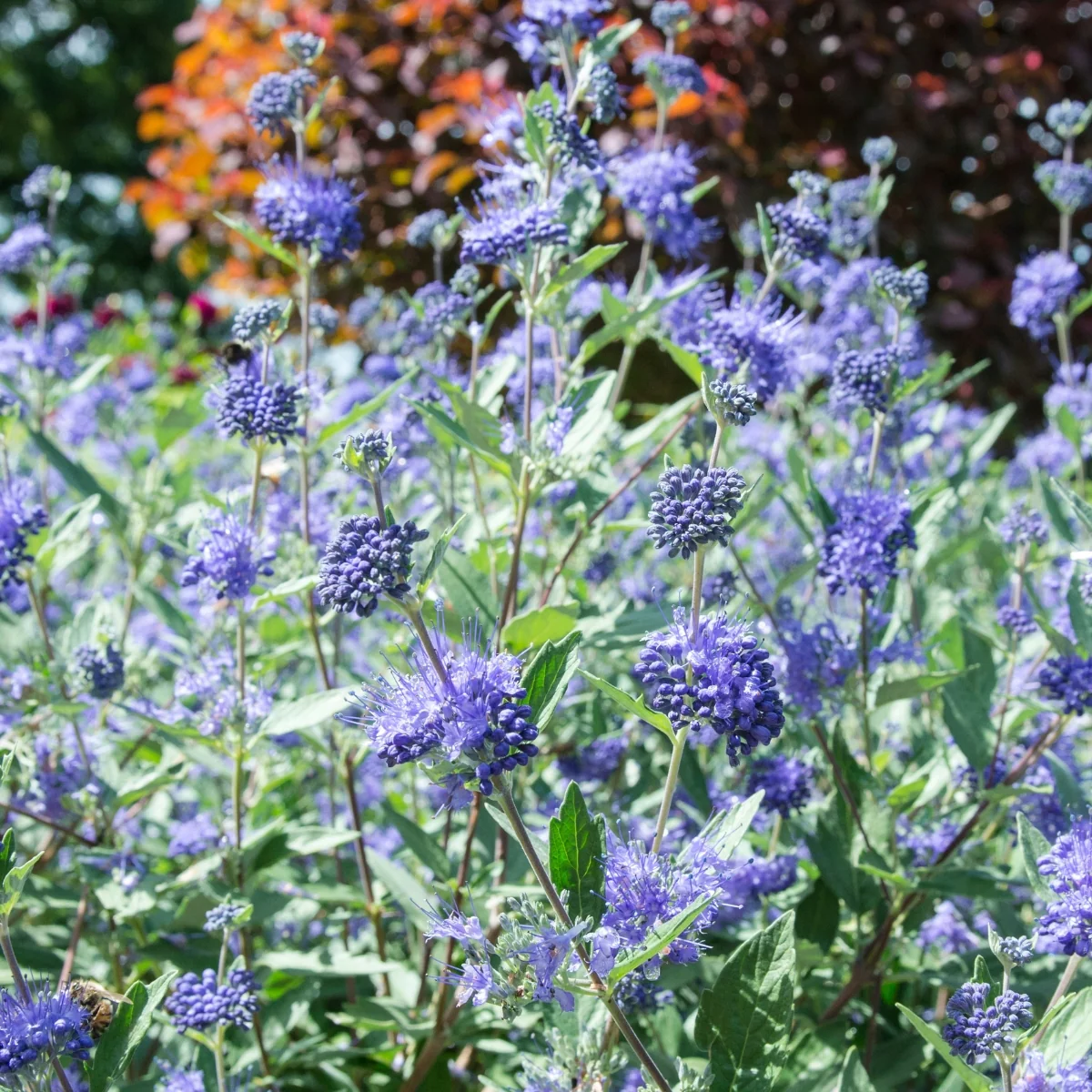
Dark Knight Caryopteris
A late bloomer that keeps the garden energized.
Dark Knight Bluebeard is one of those shrubs that becomes most valuable exactly when the landscape starts to need fresh color. In late summer and into early fall, it lights up with clusters of deep blue to purplish-blue flowers just as many earlier bloomers are easing off. That bloom timing makes it a smart choice for gardeners who want to stretch the season rather than repeat the same spring show.
Silver-gray foliage gives the plant a distinctive look even before it blooms.
One of the strongest ornamental features of Dark Knight Bluebeard is the contrast between its deep blue flowers and its aromatic silver-gray foliage. The leaves add texture and a slightly cool-toned cast to sunny borders, which helps the flower color read even more intensely once blooming begins. It is a shrub that looks useful in the landscape even before the main show starts.
Pollinators stay active around it late in the season.
Dark Knight Bluebeard is especially valuable in pollinator gardens because it flowers at a time when nectar sources can become more limited. Bees, butterflies, hummingbirds, and other beneficial insects are drawn to the blooms, helping keep the garden active well into late summer and early fall.
A strong fit for borders, foundations, and sunny mixed beds.
Because it stays compact and mounded, Dark Knight Bluebeard fits neatly into smaller landscape beds, front-of-border placements, foundation accents, and mixed perennial gardens. It pairs especially well with coneflowers, salvias, black-eyed Susans, yarrow, and ornamental grasses that also peak in the hotter part of the season.
Easy care makes it highly practical.
Dark Knight Bluebeard performs best in full sun and average, well-drained soil. Once established, it handles mild drought better than many flowering shrubs and is widely regarded as deer-resistant and rabbit-resistant. Since it blooms on new wood, annual spring pruning helps keep it tidy, vigorous, and full of flowers.
A late bloomer that keeps the garden energized.
Dark Knight Bluebeard is one of those shrubs that becomes most valuable exactly when the landscape starts to need fresh color. In late summer and into early fall, it lights up with clusters of deep blue to purplish-blue flowers just as many earlier bloomers are easing off. That bloom timing makes it a smart choice for gardeners who want to stretch the season rather than repeat the same spring show.
Silver-gray foliage gives the plant a distinctive look even before it blooms.
One of the strongest ornamental features of Dark Knight Bluebeard is the contrast between its deep blue flowers and its aromatic silver-gray foliage. The leaves add texture and a slightly cool-toned cast to sunny borders, which helps the flower color read even more intensely once blooming begins. It is a shrub that looks useful in the landscape even before the main show starts.
Pollinators stay active around it late in the season.
Dark Knight Bluebeard is especially valuable in pollinator gardens because it flowers at a time when nectar sources can become more limited. Bees, butterflies, hummingbirds, and other beneficial insects are drawn to the blooms, helping keep the garden active well into late summer and early fall.
A strong fit for borders, foundations, and sunny mixed beds.
Because it stays compact and mounded, Dark Knight Bluebeard fits neatly into smaller landscape beds, front-of-border placements, foundation accents, and mixed perennial gardens. It pairs especially well with coneflowers, salvias, black-eyed Susans, yarrow, and ornamental grasses that also peak in the hotter part of the season.
Easy care makes it highly practical.
Dark Knight Bluebeard performs best in full sun and average, well-drained soil. Once established, it handles mild drought better than many flowering shrubs and is widely regarded as deer-resistant and rabbit-resistant. Since it blooms on new wood, annual spring pruning helps keep it tidy, vigorous, and full of flowers.
Original: $89.95
-70%$89.95
$26.98Description
A late bloomer that keeps the garden energized.
Dark Knight Bluebeard is one of those shrubs that becomes most valuable exactly when the landscape starts to need fresh color. In late summer and into early fall, it lights up with clusters of deep blue to purplish-blue flowers just as many earlier bloomers are easing off. That bloom timing makes it a smart choice for gardeners who want to stretch the season rather than repeat the same spring show.
Silver-gray foliage gives the plant a distinctive look even before it blooms.
One of the strongest ornamental features of Dark Knight Bluebeard is the contrast between its deep blue flowers and its aromatic silver-gray foliage. The leaves add texture and a slightly cool-toned cast to sunny borders, which helps the flower color read even more intensely once blooming begins. It is a shrub that looks useful in the landscape even before the main show starts.
Pollinators stay active around it late in the season.
Dark Knight Bluebeard is especially valuable in pollinator gardens because it flowers at a time when nectar sources can become more limited. Bees, butterflies, hummingbirds, and other beneficial insects are drawn to the blooms, helping keep the garden active well into late summer and early fall.
A strong fit for borders, foundations, and sunny mixed beds.
Because it stays compact and mounded, Dark Knight Bluebeard fits neatly into smaller landscape beds, front-of-border placements, foundation accents, and mixed perennial gardens. It pairs especially well with coneflowers, salvias, black-eyed Susans, yarrow, and ornamental grasses that also peak in the hotter part of the season.
Easy care makes it highly practical.
Dark Knight Bluebeard performs best in full sun and average, well-drained soil. Once established, it handles mild drought better than many flowering shrubs and is widely regarded as deer-resistant and rabbit-resistant. Since it blooms on new wood, annual spring pruning helps keep it tidy, vigorous, and full of flowers.