Adenium obesum (Desert Rose Plant)
A Living Sculpture That Loves the Sun
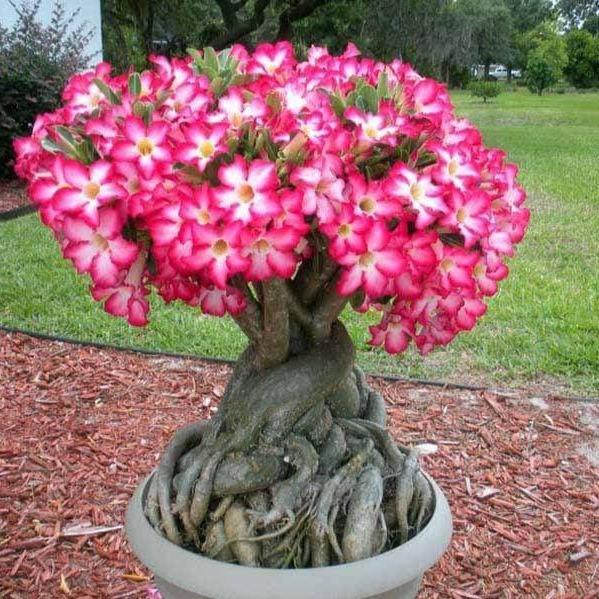
The Desert Rose plant (Adenium obesum) is a flowering succulent that resembles a piece of modern art. A thick, swollen trunk (caudex) stores water like a miniature baobab, while glossy green leaves frame clusters of bright, trumpet-shaped blooms in shades of pink, red, and white. Native to arid regions of Africa and the Arabian Peninsula, the Desert Rose thrives in warm, sunny conditions with good drainage, rewarding good conditions with eye-catching color and a distinctive silhouette.
Caudex-Forming, Compact, and Bonsai-Friendly
Desert Rose naturally forms a stout, bottle-shaped caudex topped by branching, woody stems and clusters of leaves. In containers, plants typically reach 1–3 feet in height and width, depending on age, pot size, and pruning.
The slow to moderate growth rate makes it an excellent candidate for bonsai-style training: you can gradually expose more of the caudex, shape the canopy, and develop a unique, sculptural form over time. In warm, frost-free climates, the Desert Rose can be grown outdoors in the ground or in large planters. In cooler regions, it thrives as a sun-loving patio plant that is brought indoors for winter.
Full Sun, Sharp Drainage, and Soak-and-Dry Watering
Desert Rose is a true sun-worshipper. It performs best with at least six hours of direct sunlight daily, whether that’s on a sunny patio, balcony, or in a bright south- or west-facing window indoors.
The roots demand excellent drainage: use a cactus or succulent mix amended with coarse sand, perlite, or pumice so water runs through quickly and the caudex never sits in soggy soil.
Water on a “soak-and-dry” schedule—thoroughly drench the soil, let excess drain away, then wait until the mix is completely dry before watering again. During winter dormancy, watering is reduced drastically or paused entirely.
Desert Rose thrives in warm temperatures between approximately 70°F and 95°F and must be protected from cold. It is not frost-tolerant; plants should be brought indoors or sheltered when temperatures drop below 50°F.
Truly a Patio Star, Specimen Container, and Bonsai
In the landscape, Desert Rose is almost always used in containers where its caudex and branching structure can be showcased. On sunny patios and decks, it becomes a conversation-piece focal point in terracotta or decorative stone pots. In frost-free zones, it may be planted in raised, sharply drained beds as a small accent shrub. Indoors, it serves as a bright-window specimen, a sunroom feature plant, or a living bonsai on a stand or shelf. Pair Desert Rose with other drought-tolerant companions like sedums, dwarf agaves, and small cacti, or let a single plant stand alone to highlight its sculptural trunk and luminous blooms.
A Living Sculpture That Loves the Sun
The Desert Rose plant (Adenium obesum) is a flowering succulent that resembles a piece of modern art. A thick, swollen trunk (caudex) stores water like a miniature baobab, while glossy green leaves frame clusters of bright, trumpet-shaped blooms in shades of pink, red, and white. Native to arid regions of Africa and the Arabian Peninsula, the Desert Rose thrives in warm, sunny conditions with good drainage, rewarding good conditions with eye-catching color and a distinctive silhouette.
Caudex-Forming, Compact, and Bonsai-Friendly
Desert Rose naturally forms a stout, bottle-shaped caudex topped by branching, woody stems and clusters of leaves. In containers, plants typically reach 1–3 feet in height and width, depending on age, pot size, and pruning.
The slow to moderate growth rate makes it an excellent candidate for bonsai-style training: you can gradually expose more of the caudex, shape the canopy, and develop a unique, sculptural form over time. In warm, frost-free climates, the Desert Rose can be grown outdoors in the ground or in large planters. In cooler regions, it thrives as a sun-loving patio plant that is brought indoors for winter.
Full Sun, Sharp Drainage, and Soak-and-Dry Watering
Desert Rose is a true sun-worshipper. It performs best with at least six hours of direct sunlight daily, whether that’s on a sunny patio, balcony, or in a bright south- or west-facing window indoors.
The roots demand excellent drainage: use a cactus or succulent mix amended with coarse sand, perlite, or pumice so water runs through quickly and the caudex never sits in soggy soil.
Water on a “soak-and-dry” schedule—thoroughly drench the soil, let excess drain away, then wait until the mix is completely dry before watering again. During winter dormancy, watering is reduced drastically or paused entirely.
Desert Rose thrives in warm temperatures between approximately 70°F and 95°F and must be protected from cold. It is not frost-tolerant; plants should be brought indoors or sheltered when temperatures drop below 50°F.
Truly a Patio Star, Specimen Container, and Bonsai
In the landscape, Desert Rose is almost always used in containers where its caudex and branching structure can be showcased. On sunny patios and decks, it becomes a conversation-piece focal point in terracotta or decorative stone pots. In frost-free zones, it may be planted in raised, sharply drained beds as a small accent shrub. Indoors, it serves as a bright-window specimen, a sunroom feature plant, or a living bonsai on a stand or shelf. Pair Desert Rose with other drought-tolerant companions like sedums, dwarf agaves, and small cacti, or let a single plant stand alone to highlight its sculptural trunk and luminous blooms.
Original: $89.95
-70%$89.95
$26.98Description
A Living Sculpture That Loves the Sun
The Desert Rose plant (Adenium obesum) is a flowering succulent that resembles a piece of modern art. A thick, swollen trunk (caudex) stores water like a miniature baobab, while glossy green leaves frame clusters of bright, trumpet-shaped blooms in shades of pink, red, and white. Native to arid regions of Africa and the Arabian Peninsula, the Desert Rose thrives in warm, sunny conditions with good drainage, rewarding good conditions with eye-catching color and a distinctive silhouette.
Caudex-Forming, Compact, and Bonsai-Friendly
Desert Rose naturally forms a stout, bottle-shaped caudex topped by branching, woody stems and clusters of leaves. In containers, plants typically reach 1–3 feet in height and width, depending on age, pot size, and pruning.
The slow to moderate growth rate makes it an excellent candidate for bonsai-style training: you can gradually expose more of the caudex, shape the canopy, and develop a unique, sculptural form over time. In warm, frost-free climates, the Desert Rose can be grown outdoors in the ground or in large planters. In cooler regions, it thrives as a sun-loving patio plant that is brought indoors for winter.
Full Sun, Sharp Drainage, and Soak-and-Dry Watering
Desert Rose is a true sun-worshipper. It performs best with at least six hours of direct sunlight daily, whether that’s on a sunny patio, balcony, or in a bright south- or west-facing window indoors.
The roots demand excellent drainage: use a cactus or succulent mix amended with coarse sand, perlite, or pumice so water runs through quickly and the caudex never sits in soggy soil.
Water on a “soak-and-dry” schedule—thoroughly drench the soil, let excess drain away, then wait until the mix is completely dry before watering again. During winter dormancy, watering is reduced drastically or paused entirely.
Desert Rose thrives in warm temperatures between approximately 70°F and 95°F and must be protected from cold. It is not frost-tolerant; plants should be brought indoors or sheltered when temperatures drop below 50°F.
Truly a Patio Star, Specimen Container, and Bonsai
In the landscape, Desert Rose is almost always used in containers where its caudex and branching structure can be showcased. On sunny patios and decks, it becomes a conversation-piece focal point in terracotta or decorative stone pots. In frost-free zones, it may be planted in raised, sharply drained beds as a small accent shrub. Indoors, it serves as a bright-window specimen, a sunroom feature plant, or a living bonsai on a stand or shelf. Pair Desert Rose with other drought-tolerant companions like sedums, dwarf agaves, and small cacti, or let a single plant stand alone to highlight its sculptural trunk and luminous blooms.