American Witch Hazel
A native shrub that blooms when almost everything else is finished.
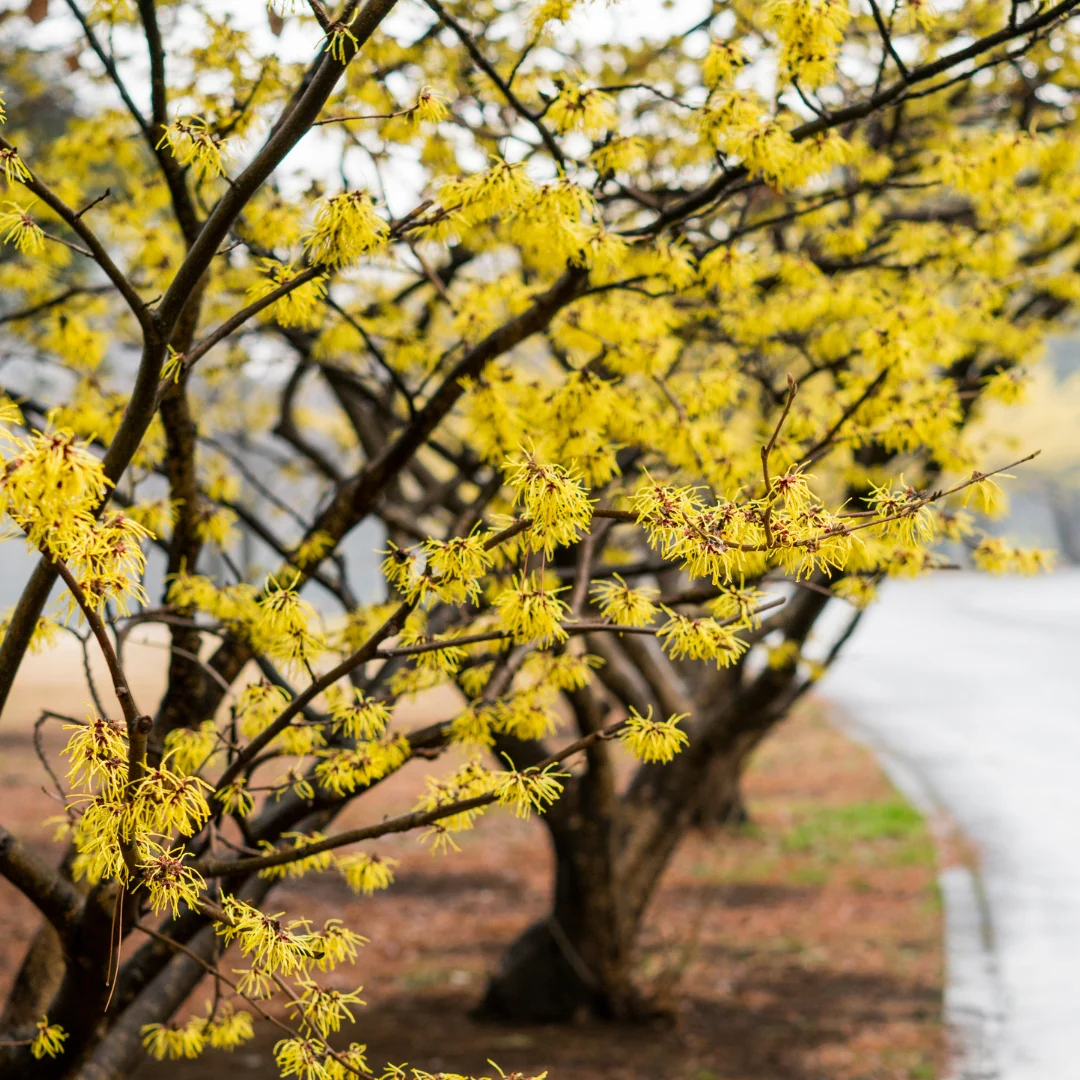
American Witch Hazel is one of the most distinctive native shrubs in the landscape because it flowers in the fall rather than in spring. As the season winds down, its narrow ribbon-like yellow petals begin to open along the branches, creating a soft but unmistakable display at a time when very few woody plants are still flowering. That unusual bloom season is a major part of its charm.
Fall foliage and flowers often overlap for extra seasonal impact.
One of the most appealing things about American Witch Hazel is the way its yellow flowers often appear as the foliage turns golden and begins to drop. That overlap creates a layered autumn display that feels especially rich in woodland gardens, native borders, and naturalized plantings. It gives the shrub a different kind of beauty than a typical spring bloomer.
A large native shrub with a graceful, natural habit.
American Witch Hazel usually grows as a broad, multi-stemmed shrub or small tree with a spreading, vase-like form. It has enough size and presence to anchor a planting, but it still feels loose and natural rather than rigid or overly formal. In the right setting, it becomes a memorable focal point with year-round structure.
A strong fit for woodland edges, native screens, and specimen use.
This shrub works especially well in woodland gardens, mixed native borders, naturalized areas, and larger foundation-free spaces where its mature size can be appreciated. It can be used as a specimen, a tall informal screen, or part of a layered native planting beneath or beside larger canopy trees. Its character is best suited to landscapes that welcome a more natural form.
Easy to grow when given room and the right setting.
American Witch Hazel performs best in full sun to partial shade and in well-drained, slightly acidic to neutral soil, though it is adaptable to a range of conditions once established. It is generally low maintenance and becomes more drought-tolerant over time. Because it can grow into a substantial, large shrub or small tree, it is best planted where it has room to develop naturally.
A native shrub that blooms when almost everything else is finished.
American Witch Hazel is one of the most distinctive native shrubs in the landscape because it flowers in the fall rather than in spring. As the season winds down, its narrow ribbon-like yellow petals begin to open along the branches, creating a soft but unmistakable display at a time when very few woody plants are still flowering. That unusual bloom season is a major part of its charm.
Fall foliage and flowers often overlap for extra seasonal impact.
One of the most appealing things about American Witch Hazel is the way its yellow flowers often appear as the foliage turns golden and begins to drop. That overlap creates a layered autumn display that feels especially rich in woodland gardens, native borders, and naturalized plantings. It gives the shrub a different kind of beauty than a typical spring bloomer.
A large native shrub with a graceful, natural habit.
American Witch Hazel usually grows as a broad, multi-stemmed shrub or small tree with a spreading, vase-like form. It has enough size and presence to anchor a planting, but it still feels loose and natural rather than rigid or overly formal. In the right setting, it becomes a memorable focal point with year-round structure.
A strong fit for woodland edges, native screens, and specimen use.
This shrub works especially well in woodland gardens, mixed native borders, naturalized areas, and larger foundation-free spaces where its mature size can be appreciated. It can be used as a specimen, a tall informal screen, or part of a layered native planting beneath or beside larger canopy trees. Its character is best suited to landscapes that welcome a more natural form.
Easy to grow when given room and the right setting.
American Witch Hazel performs best in full sun to partial shade and in well-drained, slightly acidic to neutral soil, though it is adaptable to a range of conditions once established. It is generally low maintenance and becomes more drought-tolerant over time. Because it can grow into a substantial, large shrub or small tree, it is best planted where it has room to develop naturally.
Description
A native shrub that blooms when almost everything else is finished.
American Witch Hazel is one of the most distinctive native shrubs in the landscape because it flowers in the fall rather than in spring. As the season winds down, its narrow ribbon-like yellow petals begin to open along the branches, creating a soft but unmistakable display at a time when very few woody plants are still flowering. That unusual bloom season is a major part of its charm.
Fall foliage and flowers often overlap for extra seasonal impact.
One of the most appealing things about American Witch Hazel is the way its yellow flowers often appear as the foliage turns golden and begins to drop. That overlap creates a layered autumn display that feels especially rich in woodland gardens, native borders, and naturalized plantings. It gives the shrub a different kind of beauty than a typical spring bloomer.
A large native shrub with a graceful, natural habit.
American Witch Hazel usually grows as a broad, multi-stemmed shrub or small tree with a spreading, vase-like form. It has enough size and presence to anchor a planting, but it still feels loose and natural rather than rigid or overly formal. In the right setting, it becomes a memorable focal point with year-round structure.
A strong fit for woodland edges, native screens, and specimen use.
This shrub works especially well in woodland gardens, mixed native borders, naturalized areas, and larger foundation-free spaces where its mature size can be appreciated. It can be used as a specimen, a tall informal screen, or part of a layered native planting beneath or beside larger canopy trees. Its character is best suited to landscapes that welcome a more natural form.
Easy to grow when given room and the right setting.
American Witch Hazel performs best in full sun to partial shade and in well-drained, slightly acidic to neutral soil, though it is adaptable to a range of conditions once established. It is generally low maintenance and becomes more drought-tolerant over time. Because it can grow into a substantial, large shrub or small tree, it is best planted where it has room to develop naturally.