Show Off® Sugar Baby® Forsythia
Bright Yellow Spring Flowers In A True Small-Space Forsythia
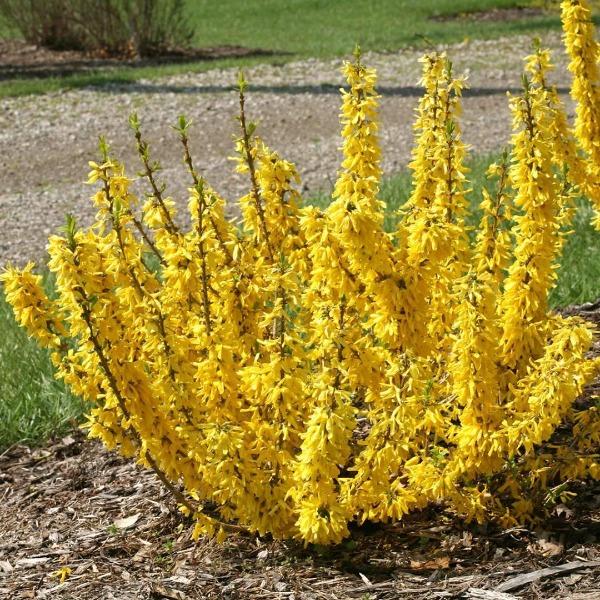
Show Off® Sugar Baby® Forsythia delivers the classic “forsythia sunshine” moment—those vivid yellow flowers that arrive early and announce spring—without the big, sprawling size of older varieties. In early spring, branches light up with bloom clusters that make the whole plant glow, filling that late-winter color gap when gardens are still mostly sleeping. It’s the kind of shrub that makes a front bed feel instantly cheerful and intentional, even before perennials wake up.
Because it stays compact, Sugar Baby® is perfect for places where you actually see it: near the entry, along a walkway, at the front of a border, or tucked into a foundation bed where a full-size forsythia would be way too much. It also pairs beautifully with spring bulbs—daffodils and tulips at its feet look even brighter against that yellow bloom cloud. If you want early-season curb appeal that doesn’t require a lot of space, this forsythia fits the plan.
Compact, Dense Habit That Stays Neat Without Constant Shaping
Sugar Baby® is a dwarf forsythia that typically matures around 2–3 feet tall and about 2–3 feet wide, forming a dense, upright-to-mounded shrub with good branching. That naturally full habit is the real win: it looks tidy without needing the aggressive shearing that can ruin bloom. In a small garden, it reads as a clean, intentional “spring highlight,” then settles into a manageable green shrub for the rest of the season.
Use it as a low flowering hedge to define a bed edge, repeat it along a walkway for a ribbon of early color, or mass a few plants for a bigger spring statement without a bigger footprint. It also works well at corners and transitions where you want a plant that stays in bounds and doesn’t block sightlines. If your landscape goal is “polished, not overgrown,” Sugar Baby® behaves like a well-trained shrub while still delivering that classic forsythia drama.
Deer-Resistant, Adaptable Performance For Busy Homeowners
Show Off® Sugar Baby® Forsythia is deer resistant, making it a stronger choice for front-yard beds and visible borders in areas where browsing is common. It’s also adaptable to typical garden soils as long as drainage is reasonable, and it performs best in full sun to partial sun. More sun generally means more flowers, but it can still bloom well with a few hours of direct light, which makes placement easier than many spring bloomers.
Establishment is simple: consistent watering in the first season, a mulch ring to stabilize moisture, and occasional deep watering during prolonged drought. That summer care matters because this year’s growth is what carries next spring’s flower buds. Keep the plant healthy through summer, and you’ll get a better bloom show the following spring. And if you love the idea of “bringing spring inside,” Sugar Baby® branches can also be cut in late winter and forced to bloom in a vase—an easy, feel-good seasonal ritual.
Prune The Right Way To Keep Blooms Heavy Every Year
Forsythia blooms on old wood, which means next spring’s flowers form on the stems that grow this year. That’s why the timing rule is everything: prune Sugar Baby® right after it finishes flowering in spring, not in late winter. Pruning later removes the buds you want for next year. Keep shaping light and focus on maintaining the plant’s naturally dense form rather than shearing it into something unnatural.
For long-term vigor, remove a few of the oldest stems at the base every couple of years to encourage fresh, flower-producing growth. If you’re using Sugar Baby® as a low hedge, do a gentle trim right after bloom and keep the base slightly wider than the top so sunlight reaches lower branches. With that simple routine, the shrub stays full, blooms hard, and keeps its compact size without sacrificing the spring show you planted it for.
Bright Yellow Spring Flowers In A True Small-Space Forsythia
Show Off® Sugar Baby® Forsythia delivers the classic “forsythia sunshine” moment—those vivid yellow flowers that arrive early and announce spring—without the big, sprawling size of older varieties. In early spring, branches light up with bloom clusters that make the whole plant glow, filling that late-winter color gap when gardens are still mostly sleeping. It’s the kind of shrub that makes a front bed feel instantly cheerful and intentional, even before perennials wake up.
Because it stays compact, Sugar Baby® is perfect for places where you actually see it: near the entry, along a walkway, at the front of a border, or tucked into a foundation bed where a full-size forsythia would be way too much. It also pairs beautifully with spring bulbs—daffodils and tulips at its feet look even brighter against that yellow bloom cloud. If you want early-season curb appeal that doesn’t require a lot of space, this forsythia fits the plan.
Compact, Dense Habit That Stays Neat Without Constant Shaping
Sugar Baby® is a dwarf forsythia that typically matures around 2–3 feet tall and about 2–3 feet wide, forming a dense, upright-to-mounded shrub with good branching. That naturally full habit is the real win: it looks tidy without needing the aggressive shearing that can ruin bloom. In a small garden, it reads as a clean, intentional “spring highlight,” then settles into a manageable green shrub for the rest of the season.
Use it as a low flowering hedge to define a bed edge, repeat it along a walkway for a ribbon of early color, or mass a few plants for a bigger spring statement without a bigger footprint. It also works well at corners and transitions where you want a plant that stays in bounds and doesn’t block sightlines. If your landscape goal is “polished, not overgrown,” Sugar Baby® behaves like a well-trained shrub while still delivering that classic forsythia drama.
Deer-Resistant, Adaptable Performance For Busy Homeowners
Show Off® Sugar Baby® Forsythia is deer resistant, making it a stronger choice for front-yard beds and visible borders in areas where browsing is common. It’s also adaptable to typical garden soils as long as drainage is reasonable, and it performs best in full sun to partial sun. More sun generally means more flowers, but it can still bloom well with a few hours of direct light, which makes placement easier than many spring bloomers.
Establishment is simple: consistent watering in the first season, a mulch ring to stabilize moisture, and occasional deep watering during prolonged drought. That summer care matters because this year’s growth is what carries next spring’s flower buds. Keep the plant healthy through summer, and you’ll get a better bloom show the following spring. And if you love the idea of “bringing spring inside,” Sugar Baby® branches can also be cut in late winter and forced to bloom in a vase—an easy, feel-good seasonal ritual.
Prune The Right Way To Keep Blooms Heavy Every Year
Forsythia blooms on old wood, which means next spring’s flowers form on the stems that grow this year. That’s why the timing rule is everything: prune Sugar Baby® right after it finishes flowering in spring, not in late winter. Pruning later removes the buds you want for next year. Keep shaping light and focus on maintaining the plant’s naturally dense form rather than shearing it into something unnatural.
For long-term vigor, remove a few of the oldest stems at the base every couple of years to encourage fresh, flower-producing growth. If you’re using Sugar Baby® as a low hedge, do a gentle trim right after bloom and keep the base slightly wider than the top so sunlight reaches lower branches. With that simple routine, the shrub stays full, blooms hard, and keeps its compact size without sacrificing the spring show you planted it for.
Original: $89.95
-70%$89.95
$26.98Description
Bright Yellow Spring Flowers In A True Small-Space Forsythia
Show Off® Sugar Baby® Forsythia delivers the classic “forsythia sunshine” moment—those vivid yellow flowers that arrive early and announce spring—without the big, sprawling size of older varieties. In early spring, branches light up with bloom clusters that make the whole plant glow, filling that late-winter color gap when gardens are still mostly sleeping. It’s the kind of shrub that makes a front bed feel instantly cheerful and intentional, even before perennials wake up.
Because it stays compact, Sugar Baby® is perfect for places where you actually see it: near the entry, along a walkway, at the front of a border, or tucked into a foundation bed where a full-size forsythia would be way too much. It also pairs beautifully with spring bulbs—daffodils and tulips at its feet look even brighter against that yellow bloom cloud. If you want early-season curb appeal that doesn’t require a lot of space, this forsythia fits the plan.
Compact, Dense Habit That Stays Neat Without Constant Shaping
Sugar Baby® is a dwarf forsythia that typically matures around 2–3 feet tall and about 2–3 feet wide, forming a dense, upright-to-mounded shrub with good branching. That naturally full habit is the real win: it looks tidy without needing the aggressive shearing that can ruin bloom. In a small garden, it reads as a clean, intentional “spring highlight,” then settles into a manageable green shrub for the rest of the season.
Use it as a low flowering hedge to define a bed edge, repeat it along a walkway for a ribbon of early color, or mass a few plants for a bigger spring statement without a bigger footprint. It also works well at corners and transitions where you want a plant that stays in bounds and doesn’t block sightlines. If your landscape goal is “polished, not overgrown,” Sugar Baby® behaves like a well-trained shrub while still delivering that classic forsythia drama.
Deer-Resistant, Adaptable Performance For Busy Homeowners
Show Off® Sugar Baby® Forsythia is deer resistant, making it a stronger choice for front-yard beds and visible borders in areas where browsing is common. It’s also adaptable to typical garden soils as long as drainage is reasonable, and it performs best in full sun to partial sun. More sun generally means more flowers, but it can still bloom well with a few hours of direct light, which makes placement easier than many spring bloomers.
Establishment is simple: consistent watering in the first season, a mulch ring to stabilize moisture, and occasional deep watering during prolonged drought. That summer care matters because this year’s growth is what carries next spring’s flower buds. Keep the plant healthy through summer, and you’ll get a better bloom show the following spring. And if you love the idea of “bringing spring inside,” Sugar Baby® branches can also be cut in late winter and forced to bloom in a vase—an easy, feel-good seasonal ritual.
Prune The Right Way To Keep Blooms Heavy Every Year
Forsythia blooms on old wood, which means next spring’s flowers form on the stems that grow this year. That’s why the timing rule is everything: prune Sugar Baby® right after it finishes flowering in spring, not in late winter. Pruning later removes the buds you want for next year. Keep shaping light and focus on maintaining the plant’s naturally dense form rather than shearing it into something unnatural.
For long-term vigor, remove a few of the oldest stems at the base every couple of years to encourage fresh, flower-producing growth. If you’re using Sugar Baby® as a low hedge, do a gentle trim right after bloom and keep the base slightly wider than the top so sunlight reaches lower branches. With that simple routine, the shrub stays full, blooms hard, and keeps its compact size without sacrificing the spring show you planted it for.