Blue Rug Juniper
A groundcover that solves real landscape problems beautifully
Blue Rug Juniper is an excellent choice for homeowners who want an evergreen groundcover that does more than just fill space. Its low, spreading habit helps cover bare ground quickly, soften hard edges, and create a finished look in places where turf, perennials, or larger shrubs may struggle. This is the kind of plant that brings practical coverage and ornamental value at the same time.
Silvery-blue foliage keeps the landscape bright all year
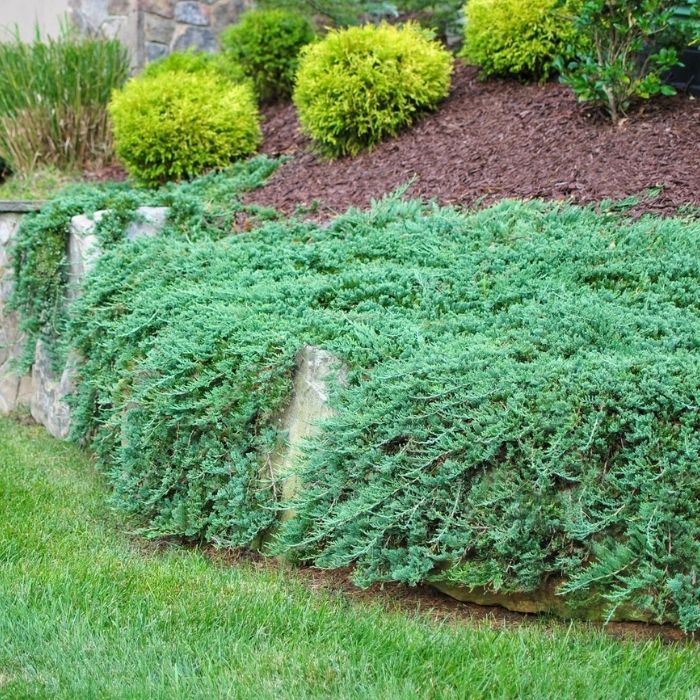
One of the biggest reasons Blue Rug Juniper stands out is its foliage color. The plant forms a dense mat of silver-blue evergreen growth that brings cool-toned contrast to the landscape in every season. In winter, that color may take on a slightly purplish cast, which adds another layer of seasonal character without losing the plant’s value as a groundcover.
Its creeping habit makes it excellent for erosion control
Blue Rug Juniper stays very low to the ground, but it spreads broadly over time. That growth habit makes it especially useful on banks, slopes, and other hard-to-maintain areas where erosion control and weed suppression are important. It also works beautifully spilling over retaining walls or edging the front of sunny planting beds.
Perfect for rock gardens, borders, and large sunny spaces
This juniper is especially effective in rock gardens, gravel gardens, sunny slopes, border fronts, and large mass plantings where a broad carpet of evergreen texture is the goal. It also fits naturally into coastal and waterwise landscapes, where its salt tolerance and drought tolerance add practical value along with ornamental appeal.
Tough, drought tolerant, and easy to maintain
Blue Rug Juniper performs best in full sun and sharply drained soil. Once established, it is notably drought tolerant and generally low maintenance, needing very little pruning beyond occasional cleanup or light shaping. Deer resistance is widely cited for this plant, but as with any landscape shrub, it is best described as relative rather than absolute in areas with heavy browsing pressure.
A groundcover that solves real landscape problems beautifully
Blue Rug Juniper is an excellent choice for homeowners who want an evergreen groundcover that does more than just fill space. Its low, spreading habit helps cover bare ground quickly, soften hard edges, and create a finished look in places where turf, perennials, or larger shrubs may struggle. This is the kind of plant that brings practical coverage and ornamental value at the same time.
Silvery-blue foliage keeps the landscape bright all year
One of the biggest reasons Blue Rug Juniper stands out is its foliage color. The plant forms a dense mat of silver-blue evergreen growth that brings cool-toned contrast to the landscape in every season. In winter, that color may take on a slightly purplish cast, which adds another layer of seasonal character without losing the plant’s value as a groundcover.
Its creeping habit makes it excellent for erosion control
Blue Rug Juniper stays very low to the ground, but it spreads broadly over time. That growth habit makes it especially useful on banks, slopes, and other hard-to-maintain areas where erosion control and weed suppression are important. It also works beautifully spilling over retaining walls or edging the front of sunny planting beds.
Perfect for rock gardens, borders, and large sunny spaces
This juniper is especially effective in rock gardens, gravel gardens, sunny slopes, border fronts, and large mass plantings where a broad carpet of evergreen texture is the goal. It also fits naturally into coastal and waterwise landscapes, where its salt tolerance and drought tolerance add practical value along with ornamental appeal.
Tough, drought tolerant, and easy to maintain
Blue Rug Juniper performs best in full sun and sharply drained soil. Once established, it is notably drought tolerant and generally low maintenance, needing very little pruning beyond occasional cleanup or light shaping. Deer resistance is widely cited for this plant, but as with any landscape shrub, it is best described as relative rather than absolute in areas with heavy browsing pressure.
Original: $25.95
-70%$25.95
$7.78Description
A groundcover that solves real landscape problems beautifully
Blue Rug Juniper is an excellent choice for homeowners who want an evergreen groundcover that does more than just fill space. Its low, spreading habit helps cover bare ground quickly, soften hard edges, and create a finished look in places where turf, perennials, or larger shrubs may struggle. This is the kind of plant that brings practical coverage and ornamental value at the same time.
Silvery-blue foliage keeps the landscape bright all year
One of the biggest reasons Blue Rug Juniper stands out is its foliage color. The plant forms a dense mat of silver-blue evergreen growth that brings cool-toned contrast to the landscape in every season. In winter, that color may take on a slightly purplish cast, which adds another layer of seasonal character without losing the plant’s value as a groundcover.
Its creeping habit makes it excellent for erosion control
Blue Rug Juniper stays very low to the ground, but it spreads broadly over time. That growth habit makes it especially useful on banks, slopes, and other hard-to-maintain areas where erosion control and weed suppression are important. It also works beautifully spilling over retaining walls or edging the front of sunny planting beds.
Perfect for rock gardens, borders, and large sunny spaces
This juniper is especially effective in rock gardens, gravel gardens, sunny slopes, border fronts, and large mass plantings where a broad carpet of evergreen texture is the goal. It also fits naturally into coastal and waterwise landscapes, where its salt tolerance and drought tolerance add practical value along with ornamental appeal.
Tough, drought tolerant, and easy to maintain
Blue Rug Juniper performs best in full sun and sharply drained soil. Once established, it is notably drought tolerant and generally low maintenance, needing very little pruning beyond occasional cleanup or light shaping. Deer resistance is widely cited for this plant, but as with any landscape shrub, it is best described as relative rather than absolute in areas with heavy browsing pressure.