Frosty Ferns
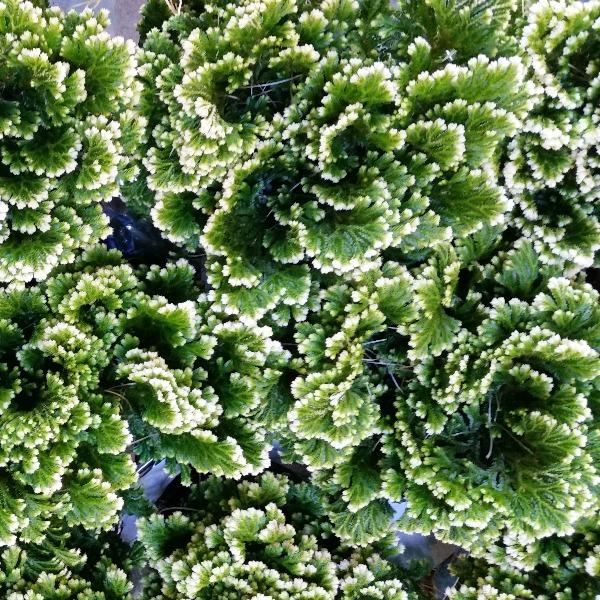
Frosty Ferns (Selaginella kraussiana or Selaginella martensii) are petite houseplants whose unique foliage has made them a popular holiday decoration. These beautiful houseplants look like they have been kissed by soft winter snow. These frosted tips are actually new leaves growing at the edge of old.
Contrary to what the name suggests, they are not actually ferns, but rather spike mosses. We have an assortment of variations of frosty ferns that can be sent out and at this time and we can not promise a customer a certain kind. Some have foliage that stands straight up, while others spillover, but all are equally as beautiful!
Frosty Ferns thrive when placed in shady locations, but can tolerate some morning sun but not much more. While it is generally used as a houseplant, it can be planted outside in the true Southern States.
As most shade plants do, these "ferns" love water and should be watered twice a week during its growing season. During the winter, when they are not growing as much, their watering can be limited to once a week. However, the soil should not get soggy, as this can lead to root rot. A simple finger test can help you determine if the Frosty Fern needs water. As always, water at the base of the plant, intentionally not watering the leaves. Wet leaves are more susceptible to burning.
Frosty Ferns (Selaginella kraussiana or Selaginella martensii) are petite houseplants whose unique foliage has made them a popular holiday decoration. These beautiful houseplants look like they have been kissed by soft winter snow. These frosted tips are actually new leaves growing at the edge of old.
Contrary to what the name suggests, they are not actually ferns, but rather spike mosses. We have an assortment of variations of frosty ferns that can be sent out and at this time and we can not promise a customer a certain kind. Some have foliage that stands straight up, while others spillover, but all are equally as beautiful!
Frosty Ferns thrive when placed in shady locations, but can tolerate some morning sun but not much more. While it is generally used as a houseplant, it can be planted outside in the true Southern States.
As most shade plants do, these "ferns" love water and should be watered twice a week during its growing season. During the winter, when they are not growing as much, their watering can be limited to once a week. However, the soil should not get soggy, as this can lead to root rot. A simple finger test can help you determine if the Frosty Fern needs water. As always, water at the base of the plant, intentionally not watering the leaves. Wet leaves are more susceptible to burning.
Description
Frosty Ferns (Selaginella kraussiana or Selaginella martensii) are petite houseplants whose unique foliage has made them a popular holiday decoration. These beautiful houseplants look like they have been kissed by soft winter snow. These frosted tips are actually new leaves growing at the edge of old.
Contrary to what the name suggests, they are not actually ferns, but rather spike mosses. We have an assortment of variations of frosty ferns that can be sent out and at this time and we can not promise a customer a certain kind. Some have foliage that stands straight up, while others spillover, but all are equally as beautiful!
Frosty Ferns thrive when placed in shady locations, but can tolerate some morning sun but not much more. While it is generally used as a houseplant, it can be planted outside in the true Southern States.
As most shade plants do, these "ferns" love water and should be watered twice a week during its growing season. During the winter, when they are not growing as much, their watering can be limited to once a week. However, the soil should not get soggy, as this can lead to root rot. A simple finger test can help you determine if the Frosty Fern needs water. As always, water at the base of the plant, intentionally not watering the leaves. Wet leaves are more susceptible to burning.