Grey Owl Juniper
A spreading evergreen that brings both coverage and character
Grey Owl Juniper is a strong choice for homeowners who want an evergreen shrub that covers space without feeling flat or ordinary. Its broad, arching habit gives it a softer, more flowing look than many upright junipers, while still delivering dependable year-round structure. This is the kind of plant that can solve practical landscape problems and still look refined doing it.
Silver-gray foliage gives the landscape a softer, cooler tone
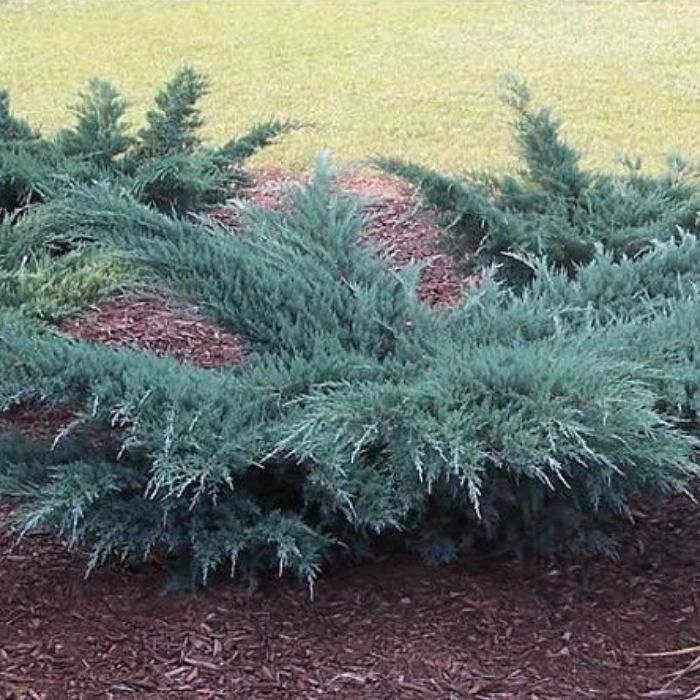
One of the biggest reasons Grey Owl Juniper stands out is its foliage color. The fine-textured evergreen growth carries a soft silver-gray tone that brightens sunny beds and creates beautiful contrast with darker shrubs, stone, brick, and mulch. That cool color stays attractive all year and gives the plant real four-season value.
Its broad spreading habit makes it especially useful on difficult sites
Grey Owl Juniper stays relatively low, but it spreads wide enough to cover a lot of ground over time. That makes it especially useful on slopes, banks, and larger sunny areas where erosion control, weed suppression, and evergreen structure all matter. It can also soften retaining walls and help tie together wide planting beds with a more natural look.
Excellent for slopes, mass plantings, and low evergreen structure
This juniper works beautifully in rock gardens, border fronts, broad foundation-free spaces, low screens, and mass plantings where width matters more than height. It is especially effective in landscapes that need a rugged, adaptable evergreen shrub with enough spread to anchor a planting and enough softness to keep it from feeling stiff.
Tough, drought tolerant, and easy to maintain
Grey Owl Juniper performs best in full sun and well-drained soil. Once established, it is notably drought tolerant and adapts to a broad range of soils, but it does not like continuously wet conditions. Deer resistance is widely associated with this plant, though it is still best described as relative rather than absolute in areas with very heavy browsing pressure.
A spreading evergreen that brings both coverage and character
Grey Owl Juniper is a strong choice for homeowners who want an evergreen shrub that covers space without feeling flat or ordinary. Its broad, arching habit gives it a softer, more flowing look than many upright junipers, while still delivering dependable year-round structure. This is the kind of plant that can solve practical landscape problems and still look refined doing it.
Silver-gray foliage gives the landscape a softer, cooler tone
One of the biggest reasons Grey Owl Juniper stands out is its foliage color. The fine-textured evergreen growth carries a soft silver-gray tone that brightens sunny beds and creates beautiful contrast with darker shrubs, stone, brick, and mulch. That cool color stays attractive all year and gives the plant real four-season value.
Its broad spreading habit makes it especially useful on difficult sites
Grey Owl Juniper stays relatively low, but it spreads wide enough to cover a lot of ground over time. That makes it especially useful on slopes, banks, and larger sunny areas where erosion control, weed suppression, and evergreen structure all matter. It can also soften retaining walls and help tie together wide planting beds with a more natural look.
Excellent for slopes, mass plantings, and low evergreen structure
This juniper works beautifully in rock gardens, border fronts, broad foundation-free spaces, low screens, and mass plantings where width matters more than height. It is especially effective in landscapes that need a rugged, adaptable evergreen shrub with enough spread to anchor a planting and enough softness to keep it from feeling stiff.
Tough, drought tolerant, and easy to maintain
Grey Owl Juniper performs best in full sun and well-drained soil. Once established, it is notably drought tolerant and adapts to a broad range of soils, but it does not like continuously wet conditions. Deer resistance is widely associated with this plant, though it is still best described as relative rather than absolute in areas with very heavy browsing pressure.
Original: $34.95
-70%$34.95
$10.49Description
A spreading evergreen that brings both coverage and character
Grey Owl Juniper is a strong choice for homeowners who want an evergreen shrub that covers space without feeling flat or ordinary. Its broad, arching habit gives it a softer, more flowing look than many upright junipers, while still delivering dependable year-round structure. This is the kind of plant that can solve practical landscape problems and still look refined doing it.
Silver-gray foliage gives the landscape a softer, cooler tone
One of the biggest reasons Grey Owl Juniper stands out is its foliage color. The fine-textured evergreen growth carries a soft silver-gray tone that brightens sunny beds and creates beautiful contrast with darker shrubs, stone, brick, and mulch. That cool color stays attractive all year and gives the plant real four-season value.
Its broad spreading habit makes it especially useful on difficult sites
Grey Owl Juniper stays relatively low, but it spreads wide enough to cover a lot of ground over time. That makes it especially useful on slopes, banks, and larger sunny areas where erosion control, weed suppression, and evergreen structure all matter. It can also soften retaining walls and help tie together wide planting beds with a more natural look.
Excellent for slopes, mass plantings, and low evergreen structure
This juniper works beautifully in rock gardens, border fronts, broad foundation-free spaces, low screens, and mass plantings where width matters more than height. It is especially effective in landscapes that need a rugged, adaptable evergreen shrub with enough spread to anchor a planting and enough softness to keep it from feeling stiff.
Tough, drought tolerant, and easy to maintain
Grey Owl Juniper performs best in full sun and well-drained soil. Once established, it is notably drought tolerant and adapts to a broad range of soils, but it does not like continuously wet conditions. Deer resistance is widely associated with this plant, though it is still best described as relative rather than absolute in areas with very heavy browsing pressure.