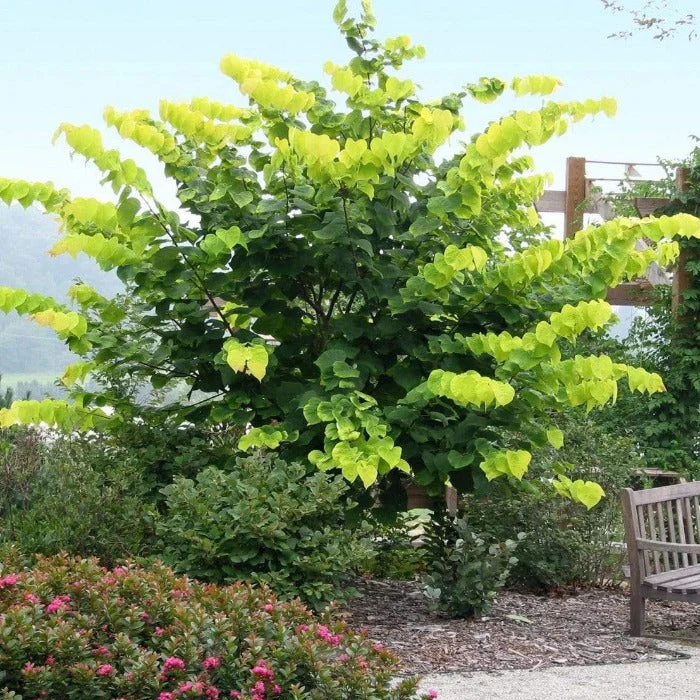
Hearts of Gold Redbud Tree
Golden Heart-Shaped Leaves That Glow All Season
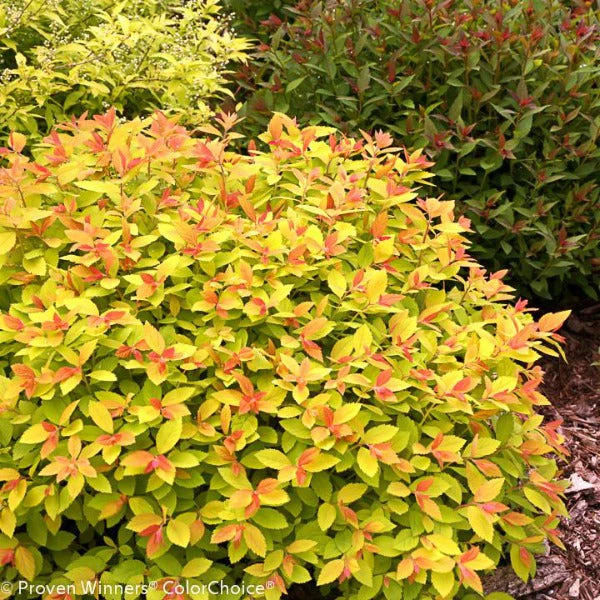
Hearts of Gold Redbud is the kind of tree that makes the whole landscape look brighter. After the spring bloom show, fresh heart-shaped leaves emerge in luminous gold tones that read like sunlight in the canopy. In many gardens, new growth starts with warm apricot notes, then quickly settles into a clear golden yellow before softening toward chartreuse as the season progresses. That color shift is part of the appeal—it looks dynamic and “alive,” not flat, and it pairs beautifully with deep greens, blue evergreens, and burgundy foliage plants.
Golden foliage also does a lot of design work in a small space. It can lift a shady corner, highlight an entry planting, and create contrast in mixed borders without flowers. Use Hearts of Gold as a focal point where you want the canopy to pop—near a patio, beside a walkway, or as a front-yard accent you’ll see every day. If you want a tree that looks intentional even when nothing is blooming, this is a standout.
Spring Flowers That Announce The Season Early
Before leaves fully emerge, Hearts of Gold delivers the classic redbud moment: clusters of rosy pink to lavender-pink blooms lining the branches in early spring. Because flowers appear along stems and older wood (not just at branch tips), the bloom show looks full and sculptural—like the tree is sprinkled with color. It’s one of the easiest ways to build early-season curb appeal, especially when the rest of the garden is still waking up.
That early timing matters for more than aesthetics. Spring-blooming trees help bring the landscape to life, adding movement and energy as pollinators actively search for early nectar sources. Plant Hearts of Gold where you’ll enjoy it in late winter and early spring—outside a favorite window, along your driveway approach, or near an entry that needs a welcoming “first bloom” statement. It’s a tree that makes spring feel official.
Right-Sized Canopy For Front Yards, Patios, And Layered Beds
Hearts of Gold is typically considered a small-to-medium ornamental tree, often maturing around 20–25 feet tall with a similar spread (sometimes a bit narrower depending on training and site). That scale is ideal for modern landscapes: big enough to feel like a real tree and provide light shade, but not so large as to overwhelm a smaller lot. It also layers beautifully in native-inspired designs as an understory tree beneath taller canopies, or as a standalone specimen in an open lawn.
Because the canopy is manageable, it’s easier to place correctly near patios, beds, and walkways. You can create a “garden ceiling” over perennials without plunging the space into heavy shade. And the golden foliage adds brightness under and around the tree, which is a rare combination—shade plus a canopy that visually lightens the scene. If you’re trying to make a yard feel designed, this tree gives you structure, color, and scale in one move.
Simple Care That Rewards Good Drainage And Smart Watering
Redbuds are generally easy-care when you give them two things: well-drained soil and consistent moisture while they establish. Hearts of Gold prefers soil that doesn’t stay wet after rain, especially in heavier clay. A simple win is planting slightly high, creating a broad mulch ring to moderate moisture swings, and watering deeply rather than frequently. Deep watering encourages roots to grow outward, improving resilience and reducing stress during summer heat.
Pruning is minimal. Most of the time, you’ll only remove dead, damaged, or rubbing branches and make small structure corrections while the tree is young. Avoid heavy pruning that fights the natural form; the goal is a clean framework that supports a balanced canopy. With the right start—sun, drainage, mulch, and steady first-year watering—Hearts of Gold becomes a long-term landscape asset that looks like you “did everything right,” even though the care is refreshingly simple.
Golden Heart-Shaped Leaves That Glow All Season
Hearts of Gold Redbud is the kind of tree that makes the whole landscape look brighter. After the spring bloom show, fresh heart-shaped leaves emerge in luminous gold tones that read like sunlight in the canopy. In many gardens, new growth starts with warm apricot notes, then quickly settles into a clear golden yellow before softening toward chartreuse as the season progresses. That color shift is part of the appeal—it looks dynamic and “alive,” not flat, and it pairs beautifully with deep greens, blue evergreens, and burgundy foliage plants.
Golden foliage also does a lot of design work in a small space. It can lift a shady corner, highlight an entry planting, and create contrast in mixed borders without flowers. Use Hearts of Gold as a focal point where you want the canopy to pop—near a patio, beside a walkway, or as a front-yard accent you’ll see every day. If you want a tree that looks intentional even when nothing is blooming, this is a standout.
Spring Flowers That Announce The Season Early
Before leaves fully emerge, Hearts of Gold delivers the classic redbud moment: clusters of rosy pink to lavender-pink blooms lining the branches in early spring. Because flowers appear along stems and older wood (not just at branch tips), the bloom show looks full and sculptural—like the tree is sprinkled with color. It’s one of the easiest ways to build early-season curb appeal, especially when the rest of the garden is still waking up.
That early timing matters for more than aesthetics. Spring-blooming trees help bring the landscape to life, adding movement and energy as pollinators actively search for early nectar sources. Plant Hearts of Gold where you’ll enjoy it in late winter and early spring—outside a favorite window, along your driveway approach, or near an entry that needs a welcoming “first bloom” statement. It’s a tree that makes spring feel official.
Right-Sized Canopy For Front Yards, Patios, And Layered Beds
Hearts of Gold is typically considered a small-to-medium ornamental tree, often maturing around 20–25 feet tall with a similar spread (sometimes a bit narrower depending on training and site). That scale is ideal for modern landscapes: big enough to feel like a real tree and provide light shade, but not so large as to overwhelm a smaller lot. It also layers beautifully in native-inspired designs as an understory tree beneath taller canopies, or as a standalone specimen in an open lawn.
Because the canopy is manageable, it’s easier to place correctly near patios, beds, and walkways. You can create a “garden ceiling” over perennials without plunging the space into heavy shade. And the golden foliage adds brightness under and around the tree, which is a rare combination—shade plus a canopy that visually lightens the scene. If you’re trying to make a yard feel designed, this tree gives you structure, color, and scale in one move.
Simple Care That Rewards Good Drainage And Smart Watering
Redbuds are generally easy-care when you give them two things: well-drained soil and consistent moisture while they establish. Hearts of Gold prefers soil that doesn’t stay wet after rain, especially in heavier clay. A simple win is planting slightly high, creating a broad mulch ring to moderate moisture swings, and watering deeply rather than frequently. Deep watering encourages roots to grow outward, improving resilience and reducing stress during summer heat.
Pruning is minimal. Most of the time, you’ll only remove dead, damaged, or rubbing branches and make small structure corrections while the tree is young. Avoid heavy pruning that fights the natural form; the goal is a clean framework that supports a balanced canopy. With the right start—sun, drainage, mulch, and steady first-year watering—Hearts of Gold becomes a long-term landscape asset that looks like you “did everything right,” even though the care is refreshingly simple.
Original: $109.95
-70%$109.95
$32.98Description
Golden Heart-Shaped Leaves That Glow All Season
Hearts of Gold Redbud is the kind of tree that makes the whole landscape look brighter. After the spring bloom show, fresh heart-shaped leaves emerge in luminous gold tones that read like sunlight in the canopy. In many gardens, new growth starts with warm apricot notes, then quickly settles into a clear golden yellow before softening toward chartreuse as the season progresses. That color shift is part of the appeal—it looks dynamic and “alive,” not flat, and it pairs beautifully with deep greens, blue evergreens, and burgundy foliage plants.
Golden foliage also does a lot of design work in a small space. It can lift a shady corner, highlight an entry planting, and create contrast in mixed borders without flowers. Use Hearts of Gold as a focal point where you want the canopy to pop—near a patio, beside a walkway, or as a front-yard accent you’ll see every day. If you want a tree that looks intentional even when nothing is blooming, this is a standout.
Spring Flowers That Announce The Season Early
Before leaves fully emerge, Hearts of Gold delivers the classic redbud moment: clusters of rosy pink to lavender-pink blooms lining the branches in early spring. Because flowers appear along stems and older wood (not just at branch tips), the bloom show looks full and sculptural—like the tree is sprinkled with color. It’s one of the easiest ways to build early-season curb appeal, especially when the rest of the garden is still waking up.
That early timing matters for more than aesthetics. Spring-blooming trees help bring the landscape to life, adding movement and energy as pollinators actively search for early nectar sources. Plant Hearts of Gold where you’ll enjoy it in late winter and early spring—outside a favorite window, along your driveway approach, or near an entry that needs a welcoming “first bloom” statement. It’s a tree that makes spring feel official.
Right-Sized Canopy For Front Yards, Patios, And Layered Beds
Hearts of Gold is typically considered a small-to-medium ornamental tree, often maturing around 20–25 feet tall with a similar spread (sometimes a bit narrower depending on training and site). That scale is ideal for modern landscapes: big enough to feel like a real tree and provide light shade, but not so large as to overwhelm a smaller lot. It also layers beautifully in native-inspired designs as an understory tree beneath taller canopies, or as a standalone specimen in an open lawn.
Because the canopy is manageable, it’s easier to place correctly near patios, beds, and walkways. You can create a “garden ceiling” over perennials without plunging the space into heavy shade. And the golden foliage adds brightness under and around the tree, which is a rare combination—shade plus a canopy that visually lightens the scene. If you’re trying to make a yard feel designed, this tree gives you structure, color, and scale in one move.
Simple Care That Rewards Good Drainage And Smart Watering
Redbuds are generally easy-care when you give them two things: well-drained soil and consistent moisture while they establish. Hearts of Gold prefers soil that doesn’t stay wet after rain, especially in heavier clay. A simple win is planting slightly high, creating a broad mulch ring to moderate moisture swings, and watering deeply rather than frequently. Deep watering encourages roots to grow outward, improving resilience and reducing stress during summer heat.
Pruning is minimal. Most of the time, you’ll only remove dead, damaged, or rubbing branches and make small structure corrections while the tree is young. Avoid heavy pruning that fights the natural form; the goal is a clean framework that supports a balanced canopy. With the right start—sun, drainage, mulch, and steady first-year watering—Hearts of Gold becomes a long-term landscape asset that looks like you “did everything right,” even though the care is refreshingly simple.